Trials. 2018 Dec 5;19(1):671. doi: 10.1186/s13063-018-3041-5.
Assessment of chiropractic care on strength, balance, and endurance in active-duty U.S. military personnel with low back pain: a protocol for a randomized controlled trial.
Vining R1, Minkalis A2, Long CR2, Corber L2, Franklin C2, Gudavalli MR3, Xia T4, Goertz CM5.Author information1Palmer Center for Chiropractic Research, Palmer College of Chiropractic, 741 Brady St, Davenport, IA, 52803, USA. robert.vining@palmer.edu.2Palmer Center for Chiropractic Research, Palmer College of Chiropractic, 741 Brady St, Davenport, IA, 52803, USA.3College of Chiropractic Medicine, Keiser University, 2081 Vista Parkway, West Palm Beach, FL, 33411, USA.4Mechanical Engineering, Northern Illinois University, 590 Garden Rd, DeKalb, IL, 60115, USA.5The Spine Institute for Quality, 102 2nd Street, Davenport, IA, 52801,, USA.
Abstract
BACKGROUND:
Low back pain (LBP) is a common cause of disability among U.S. military personnel. Approximately 20% of all diagnoses resulting in disability discharges are linked to back-related conditions. Because LBP can negatively influence trunk muscle strength, balance, and endurance, the military readiness of active-duty military personnel with LBP is potentially compromised. Chiropractic care may facilitate the strengthening of trunk muscles, the alteration of sensory and motor signaling, and a reduction in pain sensitivity, which may contribute to improving strength, balance, and endurance for individuals with LBP. This trial will assess the effects of chiropractic care on strength, balance, and endurance for active-duty military personnel with LBP.
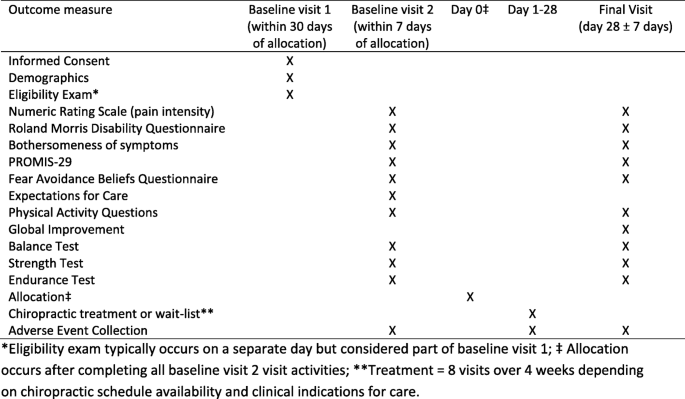
METHODS/DESIGN:This randomized controlled trial will allocate 110 active-duty military service members aged 18-40 with non-surgical acute, subacute, or chronic LBP with pain severity of ≥2/10 within the past 24 h. All study procedures are conducted at a single military treatment facility within the continental United States. Participants are recruited through recruitment materials approved by the institutional review board, such as posters and flyers, as well as through provider referrals. Group assignment occurs through computer-generated random allocation to either the study intervention (chiropractic care) or the control group (waiting list) for a 4-week period. Chiropractic care consists primarily of spinal manipulation at a frequency and duration determined by a chiropractic practitioner. Strength, balance, and endurance outcomes are obtained at baseline and after 4 weeks. The primary outcome is a change between baseline and 4 weeks of peak isometric strength, which is measured by pulling on a bimanual handle in a semi-squat position. Secondary outcomes include balance time during a single-leg standing test and trunk muscle endurance with the Biering-Sorensen test. Patient-reported outcomes include pain severity, disability measured with the Roland Morris Disability Questionnaire, symptom bothersomeness, PROMIS-29, Fear Avoidance Beliefs Questionnaire, expectations of care, physical activity, and global improvement.
DISCUSSION:This trial may help inform further research on biological mechanisms related to manual therapies employed by chiropractic practitioners.
TRIAL REGISTRATION:ClinicalTrials.gov, NCT02670148 Registered on 1 February 2016.
KEYWORDS:balance; chiropractic; endurance; low back pain; military; spinal manipulative therapy; strength
PMID:30518400PMCID:PMC6280458DOI:10.1186/s13063-018-3041-5[Indexed for MEDLINE] Free PMC Article