User blogs

By disrupting brain activity in a particular region,
neuroscientists can sway people’s views of moral situations. Publication Date: March 30, 2010
[Maybe they should study their own morality, if they have some? -ed.]
moral neuroscience
In the new study, the researchers wanted to go beyond fMRI experiments
to observe what would happen if they could actually disrupt activity in
the right TPJ. Their success marks a major step forward for the field of
moral neuroscience, says Walter Sinnott-Armstrong, professor of
philosophy at Duke University. ...
The researchers used a noninvasive technique known as transcranial
magnetic stimulation (TMS) to selectively interfere with brain activity
in the right TPJ. A magnetic field applied to a small area of the skull
creates weak electric currents that impede nearby brain cells’ ability
to fire normally, but the effect is only temporary. ...
Saxe’s lab is now studying the role of theory of mind in judging situations where the attempted harm was not a physical threat. The researchers are also doing a study on the role of the right TPJ in judgments of people who are morally lucky or unlucky. For example, a drunk driver who hits and kills a pedestrian is unlucky, compared to an equally drunk driver who makes it home safely, but the unlucky homicidal driver tends to be judged more morally blameworthy.
full article:
 Scientists say the human brain resembles the cosmos
Both neural and galactic networks have the same structure, pointing to a fractal universe.
Scientists say the human brain resembles the cosmos
Both neural and galactic networks have the same structure, pointing to a fractal universe.

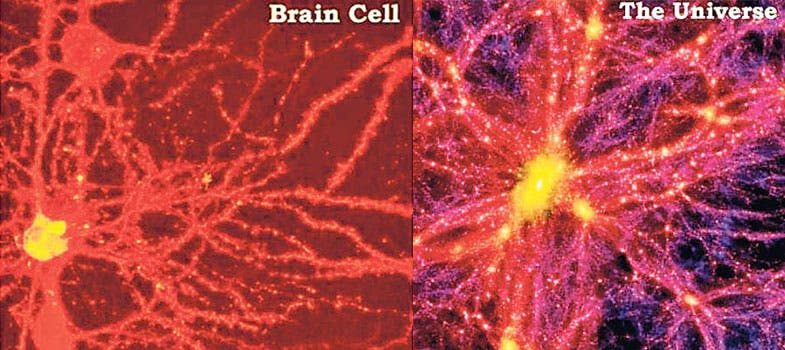
Side by side pictures of brain cells and a cosmic web of galaxies make it difficult to tell the two apart. So it can seem that the universe is like one giant brain or vice-versa, there’s a tiny universe in each of our brains. That’s not merely some entertaining thought. In a new study, an astrophysicist and a neurosurgeon have documented the striking similarities between cosmic networks of galaxies and neural networks of brain cells.
The mini-cosmos inside the brainAlberto Feletti, a neurosurgeon at the University of Verona, and Franco Vazza, astrophysicist at the University of Bologna, performed a quantitative analysis of neural and cosmic networks, showing that the natural physical processes lead to similar structures even when differences in scale can be greater than 27 orders of magnitude.
The human brain contains approximately 69 billion neurons, whereas the observable universe consists of a web of at least 100 billion galaxies. In both galactic and neural networks, just 30% of their masses are composed of ‘working’ masses, such as galaxies and neurons. The rest of the 70% of matter plays an apparently passive role: water in the brain and dark energy in the observable cosmos... more
